
Dame Vera Baird KC directs full professional inspection of CCRC’s casework by His Majesty’s Crown Prosecution Service Inspectorate
Dame Vera Baird KC, Chair of the Criminal Cases Review Commission, has directed a full professional inspection of the commission’s casework by His Majesty’s Crown Prosecution Service Inspectorate
As a key part of the Review of the Commission that Dame Vera is carrying out for the Secretary of State for Justice, she has engaged HMCPSI to carry out a comprehensive and in-depth inspection of the entire casework system at the CCRC.
HMCPSI Chief Inspector Anthony Rogers attended a CCRC staff day on Friday [3 October 2025] to set out, in broad terms, the nature of the inspection, which will commence in January 2026. He answered questions from CCRC staff.
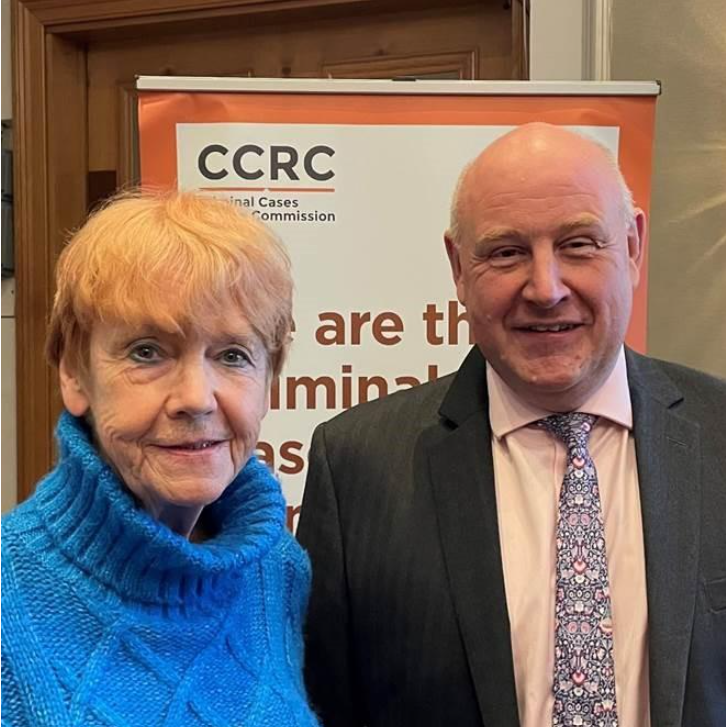
Dame Vera said: “It is important that all our stakeholders, Westminster, the public and particularly our applicants and potential applicants, can have confidence in the work we do. We know that we need the assurance of an inspection to prove that point or to make clear that we still have improvements to make.
“I am very pleased that I have been able to engage the experienced HMCPSI, who do a range of inspections by invitation and have wide experience of casework systems. This step should help to reassure everyone that we will strive to deliver the highest standards.
“The introduction of a HMCPSI inspection goes some way towards showing that we intend to be transparent, open to learning and ready to engage with partners. Our mission and sole purpose is to root out miscarriages of justice, and we intend to do it well.”
HMCPSI Chief Inspector Anthony Rogers said: “HMCPSI has been conducting independent inspection for 25 years. We have a wealth of experience which we will use as we inspect the Criminal Cases Review Commission.
“Independent inspection is vital for driving performance improvements and delivering real benefits. I welcome this opportunity to work closely with the CCRC and help strengthen their processes and ensure they fulfil their crucial mission of identifying and correcting miscarriages of justice.”
The CCRC staff team gathered in Birmingham on Friday [3 October 2025] by invitation of Dame Vera, to share ideas, discuss casework developments and, later, to hear from Anthony Rogers and his deputy, Lisa Morris.
The event, which also included updates on the Leveson Review, grooming gang issues, the CCRC’s Forensic Opportunities Programme, Post Office cases, and the special project on Imprisonment/detention for Public Protection brought together the whole organisation to develop knowledge, share experience and promote teamwork.
Dame Vera said: “We will be doing more to bring our people more frequently together, given that their contracts mean that the majority work at home. Everybody I spoke to told me how much they enjoyed and benefitted from feeling more closely part of a team.”
ENDS
Notes to Editors:
- The CCRC is an independent body set up under the Criminal Appeal Act 1995. It is responsible for independently reviewing suspected and alleged miscarriages of criminal justice in England, Wales and Northern Ireland. It is based in Birmingham and is funded by the Ministry of Justice.
- There are currently ten Commissioners who bring to the CCRC considerable experience from a wide variety of backgrounds. Commissioners are appointed by the monarch on the recommendation of the Prime Minister in accordance with the Office for the Commissioner for Public Appointments’ Code of Practice.
- The CCRC usually receives around 1,500 applications for reviews (convictions and/or sentences) each year. Since starting work in 1997, the CCRC has referred around 3% of applications to the appeal courts.
- The CCRC considers whether, as a result of new information or a new argument on a point of law, there is a real possibility that the sentence would not be upheld were a reference to be made. New information or argument on a point of law is argument or information which has not been raised during the original sentence hearing or on appeal. Applicants should usually have appealed first. A sentence can be referred in the absence of an earlier appeal only if there are “exceptional circumstances”.
- If a case is referred, it is then for the appeal court to decide whether the sentence should be changed.
- More details about the role and work of the Criminal Cases Review Commission can be found at www.ccrc.gov.uk. The CCRC can be found on X, Facebook, Instagram (@the_ccrc) and LinkedIn.